
ISOTOPE RATIO MASS
SPECTROMETRY
Isotope Ratio Mass Spectrometry (IRMS) allows us to measure the isotopic composition of the stable isotopes of light elements. IRMS activities are based on n=2 Thermo Fisher mass spectrometers installed at the CIRCE Isotope Ratio Mass Spectrometry (IRMS) laboratory (Delta V advantage) for the measurement of 13C/12C, 15N/14N, 18O/16O, 34S/32S ed 2H/1H isotope ratios.
These spectrometers can be briefly described as follows:
- an electron impact ion source producing positive ions (mostly single charged cations) housed in a single block housing (no welded) in order to reduce memory effects with low production of H3+ (< 10 ppm/nA) ions and effective suppression of 4He2+ ions for 2H/1H measurements,
- a magnetic selection at 90° double focusing (on the x,y plane) magnet (r = 0.191 m, operative mass range from 1 to 80 amu and resolution (DM/M) higher than 110) assisted by ionic optical focusing ensuring 100% beam transmission along the system;
- an array of 3 multipurpose Faraday Cups (two large and one small) for the simultaneous measurement of m/z 44,45,46 for CO2, 32,33,34 for O2, 28,29,30 for N2, 28,29 for CO e 64,66 for SO2. 2 FC cups for the measurement of 2H/1H ratios. All FC signals are acquired through High sensitivity low noise amplifiers vacuum insulated from external conditions to improve response stability.
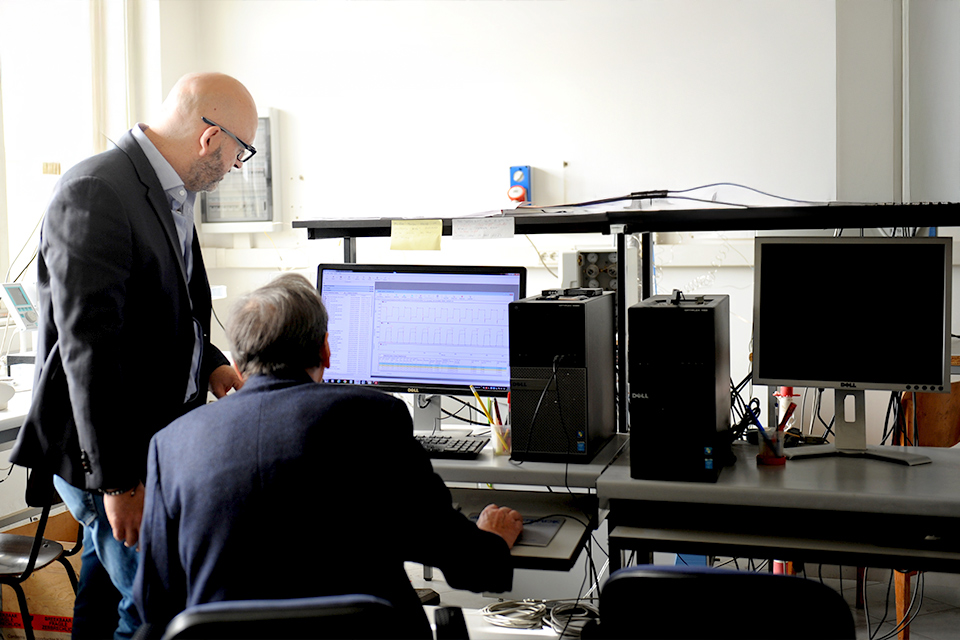
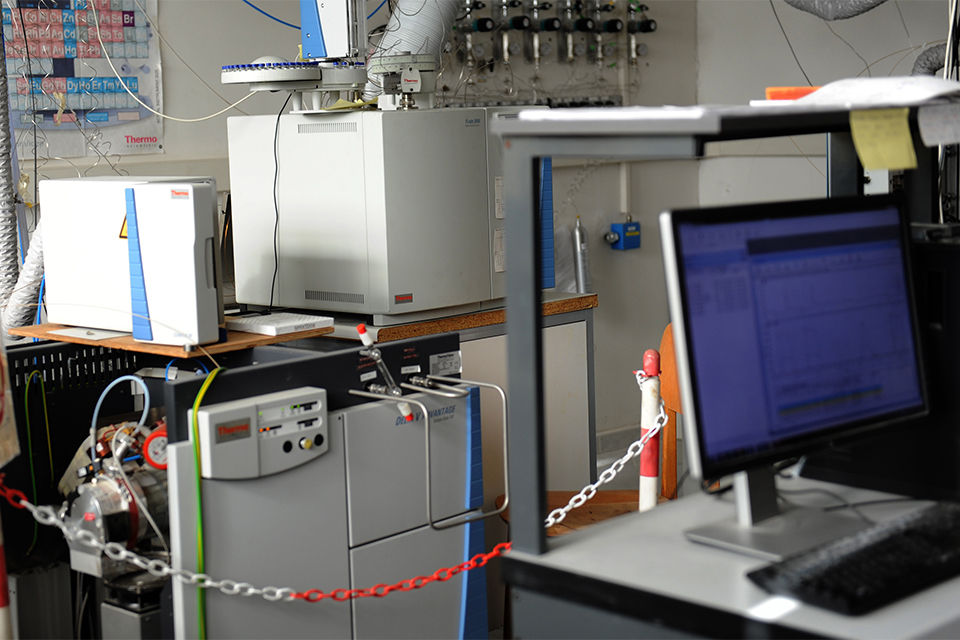
Typical total system sensitivity is 800 molecules/detected ion and 1100 molecules per detected ion in Dual Inlet (DI) and Continuous flow (CF) respectively with a signal stability for 13C (CO2) of 0.06 ‰ (1SD for 10 injections) with 5 nA current leading to 1.5 V and for 18O (CO2) 0.08 ‰ (1SD for 10 injections) with 5 nA current leading to 1.5 V in CF mode.
The following peripherals are available: two EA (1 Flash HT) for C, N and S isotope analyses solid and liquid samples; two TC/EA (1 flash HT) for O, N and H isotope analyses in solid and liquid samples; one GC/C-TC for C, N, H and O isotope analyses in specific compounds; one Gas bench for the analysis of H and O isotopes in water samples, C and O isotope analyses in Dissolved Inorganic Carbon and Carbonates and C and O isotope analyses in ambient air.
On line (continuous flow) analyses are performed via CONFLOIV peripheral capable to connect by means of the open split technology the peripherals with the IRMS.
The general categories of application include identifying the origin of an element (i.e. source apportionment) and studying the processes causing variations of isotopic composition (i.e. paleo-environmental reconstructions), as well as sample characterization in food-traceability an artwork identification.